Friday, May 22, 2015

Zinda Laash aka The Living Corpse (Khwaza Sarfraz, 1967)


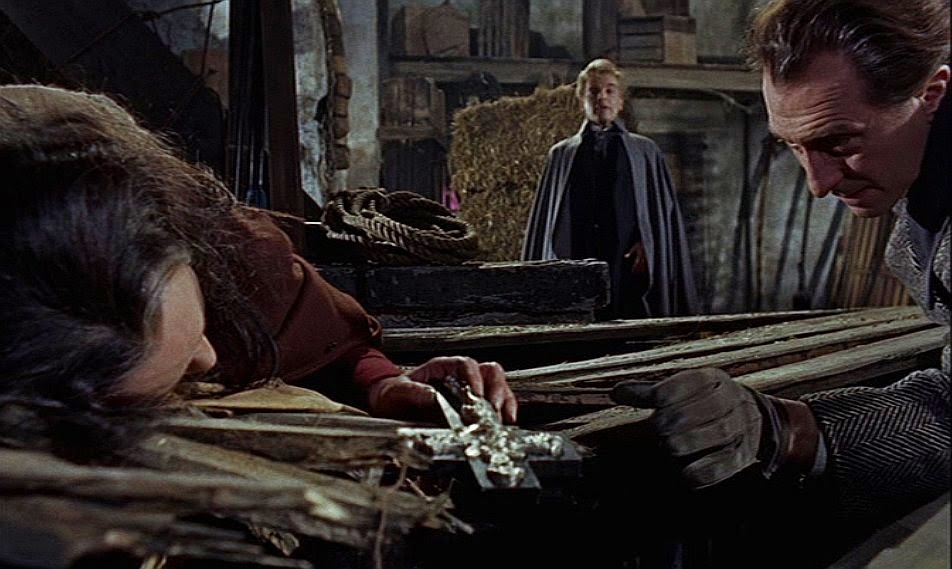
You've been here often enough to know how it goes: Jonathon Harker travels to a forbidding manse where he is greeted by a noble he doesn't realize is a vampire. At night he meets one or more of the vampire's seductive female concubines. Then she breaks into a musical number.


As an adaptation there isn't much to say of Zinda Laash except that it's quite good. It's modeled directly on Hammer's 1958 Horror of Dracula, liberally appropriating some sequences shot-for-shot as well as tracks from James Bernard's score. Those lifts are supplemented by a deranged range of musical selections that include nightclub songs, Western saloon piano, the Barber of Seville, and La Cucaracha. Some of it misses the mark tonally, but somehow altogether it works to infuse the movie with a sense of fresh energy. Shot in luminous b&w, Zinda Laash is pretty to look at and well paced. Like Horror of Dracula, Zinda Laash pares back the need for sfx – no wolf, bat, or mist transformations. Harking back to the original novel, the vampire's feeding of the kidnapped baby to an underling makes its second appearance in a Dracula adaptation. Not that the moment is explicit, bitings are discreetly staged and edited. Much more effective are the shadows and webs of the vampire's home.
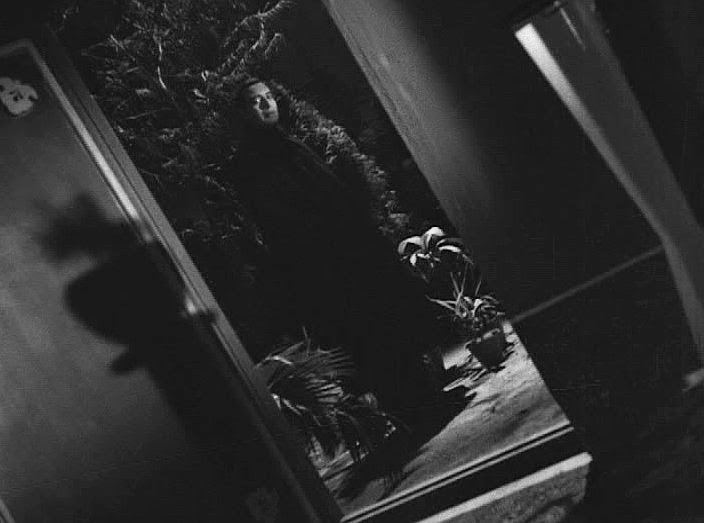


One effect I found notable was a transitional fade that occurs two or three times. You know, that old technique used for, say, werewolf transformations? The camera focuses on the actor's face, a few frames are shot, and then makeup is added in increments before shooting a few more frames. In Zinda Laash the difference between a vampire and a human is a matter of fairly subtle makeup – no Joss Whedon vampfaces here. Basically, when an actor changes from human to vampire, they just look a little less restrained of nature. So, when you see a transitional fade in this movie you're seeing an obvious fade with little or no obvious difference: the actor, a fade, and the actor looking the same. The effect calls attention to itself, and the first time it threw me. Then I realized that you don't need to see the change, the fact of the fade itself clues you in that there's been one. Subtle and brilliant.

The differences are mostly cultural: the supernatural horror aspects are kept to a minimum, which necessitates a prologue in which we learn that the Dracula character was a scientist named Tabani who vampirized himself with a potion gone wrong. No one waves any crosses about, there's not much talk of religion...and every so often the women break into song and dance (even the climactic fight sequence is choreographed to look like a dance, though I suspect this was unintentional). That's just par for the course with Lollywood (Lahore-based) cinema, a film is incomplete without musical numbers. Similar to Drakula Istanbul'da, Zinda Laash transplants the tale not only geographically but temporally as well to modern times. We've seen Dracula driving a car in other versions, but somehow it seems fundamentally wrong to see him driving a car. The styles on display are Western in attire and furnishings, and there's a strong sense of '60s youth “scene” about the movie.


Also interesting are the women of Zinda Laash. They never show much skin but are all highly sensual, not least when they dance. Human, vampire, and in transitions between they move like flames and drape themselves over the furniture with the silky fluidity of some of their costumes. Their looks smolder. Even in innocence they radiate energy, as in a beachside number. Still human, Shabnam (the Lucy character) waiting for Dracula is the most outright expression of sexual longing to appear in any Dracula movie to that date and for some time to come.


It's kind of fascinating to watch Zinda Laash thread its way between suggestive behavior and the strict moral purity imposed by Pakistan's dictatorship of the day. The censors were apoplectic that a horror film had even been made in the first place (Pakistan's second, the first being 1964's Deewana, a version of The Invisible Man). Cuts were made to some of the more provocative dance moves, and the film was finally okayed for release only upon the promise by the producers that they would never, ever again make a horror movie. Zinda Laash was released with an 'adults only' certificate, guaranteeing that everyone wanted to see it. It was a hit. Pakistani theaters were well used to horror imports, but this was their own and nigh forbidden to boot.

I saw it a month ago on YouTube and have happily added Mondo Macabro's 2003 DVD release under the alternate title “The Living Corpse” to my collection. Having only recently been a lost film, this boasts a beautifully restored image that suffers only a brief drunken wobble in one scene. It's a sweet package that includes a commentary track , new interviews the filmmakers, a clip-heavy look at Asian horror cinema, a song cut from the film, galleries, and trailers. The movie itself is in Urdu with optional English subs.

Monday, May 18, 2015

Freaks (Tod Browning, 1932)


Freaks is a movie I think of as a Voight-Kampff test. If you're not familiar with Blade Runner or the Philip K. Dick novel 'Do Androids Dream of Electric Sheep', I'll explain: administering a Voight-Kampff is how you tell a human being from an android replica. The test consists of a battery of questions and proposals designed to elicit an empathetic response. The android will not have genuine emotional responses – in theory, an android has no capacity for empathy.

On its original theatrical run in 1932 and for decades after, audiences and critics alike failed that test spectacularly.

Made and marketed as a horror film, Freaks is a colorful tale of the life of a circus troupe drawn from writer/director Tod Browning's personal recollections. We see the performers' loves, their jealousies, their rivalries and personal disputes, the bonds and the enmities they form. The great bulk of the movie is light, jovial. Emphasis is placed on the various romances (most of them frustrated in one way or another) that occur within the troupe. Some of it is daring for the era, including some risque dialog that caught the censors unaware. Phroso the Clown and Venus are taken with each other, but Venus is unable to elicit a warm physical response from Phroso (“You shoulda seen me before my operation”, he says without further elucidation). Strongman Hercules is a crude Alpha-male brute who dallies with all the camp's women. He's attracted to the show's hermaphrodite but can't admit it and so is often hostile. She seems to be attracted to him as well, but never speaks it.  The circus' owner wants to marry Violet but can't get a moment alone with her, being that she is a conjoined twin. Her sister Daisy and the owner don't get along one bit. Frieda is devoted to Hans but Hans has eyes only for trapeze artist Cleopatra.  Cleopatra plays off Hans' love in order to get closer to his money.  Hans and Frieda are little people, whom Cleo despises along with all other “freaks”.


Here is where audiences freaked: the cast is an even mix of normal-bodied folk, paraplegics and quadriplegics, gaffs (performers who fake physical abnormality), little people, microcephalics (“pinheads”), hermaphrodites, and others with genuine physical malformations of many kinds from the incredibly thin to “bird people”. That alone made “normal” audiences uncomfortable. Imagine their revulsion when Browning upped the ante by presenting the “freaks” as not only human beings but beings with sexual impulses.

This is what the critics had to say when confronted by such humanity: Script opined that the film could only appeal to “the morbidly curious and psychically sick whose libidos are stimulated by contemplating the sex lives of abnormalities and monsters”. According to the Boston Herald, “Any who enjoy watching the pitiful grotesque mistakes of nature may behold them in 'Freaks' (...) the sadistically cruel plot savors nearly of perversion”. Time magazine deemed the sideshow performers to be “subhuman animals”.

Isn't society lovely? There is an instinct we all know for social survival that could be summed up as “pick on the freak”. It works like this: to be accepted by a dominant society and thus have their protection, you must publicly hurt someone scorned by that group, someone deemed lesser or undesirable. By doing so you demonstrate your own worthiness to belong. It's ugly and cruel, and we all learn it at school either by doing it or having it done to us. Pick on the freak. Browning knows it well and cannily provides a stark example in Freaks when Hercules (recently abandoned by Venus) now woos Cleopatra. The two espy the hermaphrodite (she is never named) looking on at Hercules with heartbroken eyes. Remember, Hercules is attracted to her. In front of Cleo, though, he has to demonstrate that he's 'normal' and so shows off his masculinity by delivering the hermaphrodite a vicious black eye. Cleo responds with delighted laughter.


Bringing out the worst in each other, the pair get darker from there and so does the film. Cleo marries Hans for his money. Actress Olga Baclanova essays the role of Cleo with an air of undisguised loathing for her circumstances, having to abide the presence of so many contemptible colleagues. In the film's most celebrated scene, a wedding banquet is held at which Cleo gets drunk, literally from champagne and figuratively from her success in so easily fooling her little rube. While the troupe celebrates, mostly oblivious to her as she is to them, she proceeds to demean him openly, mocking him for his size and condescending to his apparent stupidity. Watch the way she reacts when Hercules points her attention to the sideshow performers drinking a toast to her that they accept her: “One of us! One of us!” The horror! The effrontery! The sheer, nasty insult – Cleo accepted as equals by filth! Baclanova plays a beautiful transition from boisterous hilarity to stuporous incomprehension to outrage.


Further betrayals sow an anger throughout the troupe, poisoning them all. Plans are made, vigils are kept, until one night as the caravan makes it's way through a stormy night (it has to be a storm at night, doesn't it?) varying bands form and attack each other. The sequence is a veritable lesson in filmcraft by Browning and his crew, as is the wedding feast. I've hardly even mentioned the talent on display...gloriously shot and lit, captured by a camera as fluid as the ones in Dracula were not, and set in a studio-created circus grounds that are not just convincing but inviting as a living microcosm. It's easy to immerse and lose oneself here. The script is sharp, perhaps even acidic given what's known of excised material – the censors removed some thirty minutes of material, and more was scripted but never shot. The finale involved a castration, no longer extant.


Even today, some are squeamish about that finale. Some find Browning's treatment of the circus folk to be exploitative, ambivalent...they see the sideshow people crawling beneath the carriages, wet with mud and shot in the visual language of horror cinema, and they see Browning proposing the circus folk as monstrous. In Tod Browning's reckoning, everyone ends up in the mire including the 'normals'. In 1932, Motion Picture Daily wrote that one can “not simultaneously capitalize on human misfits and pretend to pity them”. It is at least a recognition of basic human dignity, but still a failure to comprehend what's right there on the screen. When the hour of reckoning comes, it is the normal-bodied and “freak” alike who attack, or act to defend others, their courses decided not by their infirmities but by the strengths of their characters, side by side as equals and companions. In Browning's reckoning, lack of human empathy lowers us all into the mire.

Sunday, April 26, 2015

Billy the Kid vs. Dracula (William Beaudine, 1966)


If I were walking alone at night and was confronted by a reedy old man dressed like a magician who made a googly-eyed frown at me before his head lit up bright orange from within like a lantern, it'd surely give me night terrors for the rest of my life. In a movie? Not so much. (edit: this happens in most of the aged prints available, though I've now seen a restored print: the original effect is a more subdued red glow, making it one of the few reasonable elements of the movie.)

In more ways than one Billy the Kid vs. Dracula channels Universal's omnibus classic monster mash-ups of the 40's (Frankenstein Meets the Wolfman, House of Dracula and the like). No matter how bad the movie, audiences found the prospect of iconic characters going head to head irresistible. BtKvD is not a good movie, but in the spirit of Ed Wood director William Beaudine makes sincere go of it. I'm betting he loved those old movies – like Wood, he employed the language of cinema he grew up on though it was well past its sell-by date. More tellingly, he coaxed the aging John Carradine to reprise his role as Count Dracula from those '40s Universal films.

When Jess Franco and Chris Lee made a Dracula movie, the two were offering a different take on the part from that played by Lee in the Hammer series. With BtKvD, Carradine is a continuation of the same Dracula he played before – sporting top hat and cape, Carradine's interpretation was less nobleman and more circus sideshow huckster, emphasizing a bug-eyed hypnotic stare. Though Beaudine's film is in color and lacks Gothic touches, it still plays as if he thought it a direct sequel to the Universal films.

In the 1800's American West, young Melinda Plowman (Elizabeth Bentley) awaits the arrival of her never-before-met Uncle James Underhill to aid her with the ranch estate she has inherited. She is unaware that Dracula has killed her Uncle and assumed his identity in a ploy to take control of the estate and the silver mine on it. Not for the metal, though, Dracula's interest is the mine itself. For no reason given, Dracula now has a Pavlovian desire for caves (“CAVE?!” ), which I guess is a holdover from 1958's The Return of Dracula wherein the Count hid his coffin in a cave. Melinda's foreman William Bonney, whom she happens also to be engaged to, suspects something is up when the driver of the coach Underhill was riding turns up dead en route with an unnamed male corpse, and a traveling Romanian family identify Underhill as a vampire that attacked them. Melinda is going to need a hero. Lucky for her, her beau is the reformed Billy the Kid.

If Carradine's Dracula has never seemed much like Stoker's character, this Billy the Kid is likewise far removed from anyone you'd expect to have been a notorious outlaw. As William, Chuck Courtney channels the pluck and decency of an earlier era's Young Male Hero, an all-around good fella who respects the law but will punch out a bully if pushed to it. Forget the premise of two icons in conflict, once it's got your butt planted in the theater it's usefulness is spent.

I wish I could say that BtKvD is so-bad-it's-good, which it is though not quite aggressively enough. Carradine's hammy, mugging performance goes a long way toward amending that (countering the damage done by the dead-boring Billy), you could make a drinking game out of Carradine wielding his eyes at the most inapt moments. The fx are hilarious as well, fro m a ridiculous rubber bat to teleporting to the glaring orange spot that keeps setting Carradine's face on fire. Beaudine gifts the movie with bad lighting and ill-filtered day-for-night shots, all so poorly done that it becomes impossible to tell day from night. In at least one shot I was sure the rules for vampires in sunlight had been suspended.

The acting s generally as bad as the script. There's a great moment when the skeptical Melinda tells the immigrant mother (who has now been hired at the ranch) that William has asked her to confront Underhill with a mirror. The Romanian woman's horrified reply is priceless: “The Vampire Test!”. She gasps.


There's plenty more silliness in dialog and detail, including a troupe of Native Americans who want as little to do with the vampire as they do with the movie itself. In another scene Dracula is unfazed by a round of bullets but is knocked cold by having the empty gun thrown at him. BtKvD is a little dull to endure at times, but I'm beginning to grow fond of it just in writing the thing up now.

Dracula: Prince of Darkness (Terence Fisher, 1966)


If this third film in Hammer's Dracula franchise hadn't starred Christopher Lee, it would be a well-mounted but unremarkable no-frills vampire suspenser. I use the term 'starred' carefully, because it depends on his star charisma to make us overlook the fact that he's in it for all of about nine minutes and never utters a single word. It's a decent movie in it's own right, but it's Lee that gives it a kick – not a bad feat for a villain who last time we saw him had the physical consistency of Nestle's Quik (1958's Horror of Dracula saw the Count dusted by daybreak).

A group of travelers is warned away from Carlsbad and the castle there but go anyway. The survivors flee to the safety of a monastery. Dracula pursues. Plotwise and storywise, it's that basic. .The traveling foursome – couple Charles and Diana, Charles' brother Alan, and Alan's wife Helen - monopolize the film's runtime, and they are pleasant enough (barring Helen, an unceasing scold and killjoy) but bland as the script requires nothing more of them than to be vampire bait.


Early on they meet Father Sandor, our substitute for a Van Helsing type. Over multiple viewings I'm beginning to have a problem with Sandor: first he is scolding the locals for being overly cautious and superstitious about vampires, Dracula having been defeated ten years earlier (and disregarding the thriving vampire community he left in his wake, per Brides of Dracula – really, do not look to Hammer for any kind of continuity), so he wins audience sympathy for being both learned and holding a modern contempt for superstition...then once the menace is unveiled Sandor takes up their methods without a hint of irony. He presents himself as a man of the world, weary and crass as a shock tactic, yet dignified in speech. Played with gravitas by Andrew Keir, Sandor carves out a presence distinct enough from Cushing's Van Helsing that he could have well continued for further sequels...though he's beginning to wear on me a little. When he warns the wedded couple to beware the castle, he neglects to offer any reason why they should, and then rescues them later (those that survived the night) with an I-told-you-so. He's a 'designated hero', Sandor is: we're fully expected to admire him simply because he is the script's answer to the villain, and never mind that he comes across at times as a sanctimonious hypocrite. It's s not that he's unlikeable, actually he's quite warm-hearted beneath a thin gruff veil. The problem is that he's not credibly likeable...he's a little too good to be true.

More intriguing are a couple of minor villains, Klove (Phillip Latham) and Ludwig (Thorley Walters). Klove is an invention of Hammer's, an all-around manservant at Castle Dracula, a dusty old wreck faithful long after the Count has been vanquished. Ludwig is a crafty, flighty stand-in for Renfield, a mental case staying at the monastery. Thorley Walters is one of those great character actors that you instantly know (and love) from countless other films without ever quite being able to recall what they were, and he's most welcome here.

Unusually for a third film in a series, Prince of Darkness doesn't cut straight to the horror. Instead we're reminded just what a threat Dracula is via a flashback prologue (James Bernard's Dracula theme playing a vital role). It's that reminder, and Lee's unquestionable presence lying in wait, that powers the entire first half of the movie. We know the danger but our happy travelers do not, setting Hitchcock's proverbial bomb under the table of oblivious diners for fully half the film's running length of mounting suspense. Director Terrence Fisher guides the film with a a sure hand, taking his time. The careful build has a hell of a payoff, too, with Dracula's resurrection one of the nastiest bits of grue in the series and an especially ghastly death. From that point on there's no let-up in pace nor time for the characters to rest, down to one of the best of the Count's countless demises.

Continuing the aesthetic from Horror of Dracula, D:POD eschews the standard Gothic scenery – the cobwebs, the forbidding ruins, the German Expressionist shadows, thankfully no rubber bats, and instead gives us rich colors subtly used. There are a lot more deep reds employed this time, some in subtly gel-lit sets, while the rest of the screen often is splashed with color in the set décor.


Like Brides of Dracula, there is no subtext and no overt sexuality aside fro that inherent in Lee himself as Dracula. He functions as Bruce the shark from jaws, without pretense to anything other than raw hunger. Interestingly, we never see him feed this time out, but we do get our first screen treatment of the Count slicing his own bare chest for his intended to drink from. If POD brings little new to the table, we do get that nuance to the vampiric treatment of sexuality.

Ultimately the movie is a Miller Lite – tastes great, less filling. I think it's more deft than some of the later sequels, but at the same time less interesting...and it pales beside Brides of Dracula for involving story and characters. It's the shallower treatment of the characters that hurts the film a little, though there's also something to be said for the limited role Dracula plays in it. It must be remembered that in both Horror of Dracula and Stoker's novel our villain hardly puts in much of an appearance nor has has much to say once the set-up is through. Having been in development well before Lee signed , the script went through a number of revisions that could have seen it filmed as a stand-alone vampire film outside the franchise. This accounts for the slow build, as a new vampire would have needed to build its world and villain rather than get right down to business. Lee liked to claim that the dialog was so dreadful he refused to speak his lines (which begs the question of the godawful lines he uttered in Drink the Blood of Dracula), but like any good actor Lee was known to dramatize his bio a bit. Attested to by everyone else involved, there was never a script draft for POD that included lines for the Count.


Sunday, April 5, 2015

The Brides of Dracula (Terence Fisher, 1960)


Dracula is dead (see Horror of Dracula, 1958) but his progeny endure, spreading vampirism across the land. These are the “brides” of Dracula.

Marianne, a trusting young schoolmistress on her way to her appointment at a school for girls, is manipulated into spending a night at the castle of the Baroness Meinster. There she meets the Baroness' afflicted son, imprisoned by his mother and the family servant Greta. The Baron is a vampire and Marianne is to be his dinner, but Marianne is unaware of this. She decides to set him free. Thus the stage is set for the return of Peter Cushing as Van Helsing on his endless mission to exterminate the plague of vampires.

I don't have much to say about the story except that it is well-written, engaging, and proceeds at a good pace with enough plot turns to keep things form getting tired. There are no subtexts that I could spot, but the movie is imbued with a humanity fitting of a vehicle for Cushing's Van Helsing. I kept noticing how the script makes use of the quality of mercy. An innkeeper and his wife try to turn out Marianne knowing that if she stays she'll be in danger. The Baroness, a lifelong debauch like her son, nevertheless loves him and cannot bring herself to destroy him. She offers false hospitality to lure victims, but having spent a few short hours with Marianne shows signs of ambivalence if not remorse. Knowing the greater danger, a priest forces himself to be dispassionate toward the grieving father of a vampire's now undead prey. Later, Marianne places herself in harm's way to keep watch over the body of a friend.

The two most striking pieces in the film are so because they are infused with compassion. The first is the raising of a new vampire: she claws her way out of the ground* like a chick struggling to break though an eggshell while Greta coos encouragement to her. It's a spooky scene already, and the tenderness between the monsters raises it to a new level of unsettling – the human value of love evident in the inhuman. Having been instructed by the Baroness' love for her son, Greta now steps into the role of mother figure to a growing cell of brides. Greta is a fascinating character who appears too briefly, and the film could only have benefited from exploring her further.

The second standout sequence involves Van Helsing and a newly-born vampire filled with regret and horror at what she has become. Van Helsing tells her that there is a way to save herself – that she allow him to stake her. She accepts with a grateful smile, and the two await the sunrise together. It's a singular scene in vampire cinema, quiet and soulful. Cushing has a grace about him that eases the tragedy and beautifully showcases the traits that make his interpretation of Van Helsing shine.

If Brides brings anything new to the table, it's this capacity for heartfelt connection in vampires.

The script went through a number of rewrites that de-emphasized the usual focus on sexuality. That's surprising given that the lead vamp in the movie is played by young David Peel with his boyish matinee-idol looks, and that a major setting is a school for girls! Instead, the Baron comes across as a romantic cad and schemer with none of the leering. Perhaps it blunts a potential edge from the tone, it serves to distinguish this new vampire from Lee's Dracula. Any attempt to replace Lee as Dracula would have paled, so it's best that Baron Meinster be cast in a new mold entirely. The title of the film is a holdover from earlier drafts. Some have made hay of its suggestive nature linking Meinster directly to Dracula as a bride, but neither director Fisher nor the screenwriters (including Jimmy Sangster who presumably did the final draft) ever do anything with it.


Fisher does great job here. Never lurid or overstated, he maintains a solid supernatural threat balanced well with human drama and the whole flows evenly. He gets fine acting from his cast – Cushing is a given, and Martita Hunt rivals him, giving the Baroness an inner life that speaks effortlessly of history and nuances.

Jack Asher's cinematography complements Fisher's even tone with a deep focus and complex lighting that gives the actors natural tones and makes sparing use of gels in the background – usually motivated by set decor, which itself is agreeably busy. The sets and costumes are rich without being overbearing.


Brides of Dracula is, I think, one of the best of Hammer's catalog and a superior entry in their Dracula franchise. 


*The undead clawing their way out of the moil of the grave is a cliched film image by now, but I wonder when was it first seen. More specifically, when was the first time it was used in a vampire movie? I don't recall seeing it in an earlier vampire movie than Brides.

Thursday, April 2, 2015

Sinister Simian


Welcome to Sinister Simian. That title follows a line of screen-names I've been using starting with Jacques the Monkey (thank you Peter Gabriel) which became Simian Jack (a nod to Genndy Tartakovsky). More directly it is in homage to Sinister Cinema, a hosted horror program that ran every Saturday night on KATU in Portland, Oregon. Much loved and fondly remembered, Sinister Cinema is also the namesake of a home video retailer in Medford, Oregon.

If you're looking in during the early days of this blog, you're finding a glut of reviews on Dracula movies and the works of Shinya Tsukamoto. I'll be moving on from there, but I do have a ton of Dracula reviews to go – sorry. This began as a  thread on a BB elsewhere in which I intended to watch each film in quick succession and just toss out whatever random thoughts came to mind, and somehow I got stuck attempting full write-ups instead. As for Tsukamoto, he's a fave director whose work I find captivating. He's mostly known for his breakout cyberpunk hit Tetsuo, and I'd like to change that. It's worthy as a visionary piece but the director has done work since that is more profound, more beautiful, more accomplished in craft, art, and humanism.

Very few of these will be proper analyses. Two reasons for that, one is that I hope to entice readers to check out films they may not have seen, and that means trying to avoid spoilers.  I won't always do that. The other reason is, well...I'm just a casual viewer with a pedestrian background, not a film scholar. I like my summer blockbusters and pop entertainment, and while I do have a taste for things eclectic my familiarity with them remains...ummm, aspirational.  I do this for fun.

Please feel free to comment, disagreement and differences of opinion are welcome as long as they are kept civil – this isn't IMDb or AICN. We may be seeing the same movies but we aren't going to be seeing the same things in them. This isn't learned stuff, just personal reactions. I'm a cinephage: I eat up movies.

About the screencaps? Quality and availability are gonna vary. I'm trying to get them straight from my own discs but many of them I'm having to grab images off trailers on You Tube. Working to improve the situation.

One of my reasons for launching this blog is pretty oblique. I want to be known for the things I value, and this is just about the best way I can think of to show who I am.   It's a personal thing  Communication is one of the things that matter to me.  There's someone in particular out there I want to reach. 

That said, I hope you enjoy the blog.  Go watch a movie.


A Snake of June (Shinya Tsukamoto, 2002)


“Go for it. Nobody can stop you.”


I'm having a hard time finding the right intro to this review of my favorite Shinya Tsukamoto movie. The first try started with a joke because, well, sex makes people nervous and they tell weak jokes. That's not right, though, A Snake of June defies that civilized timidity about sex so it seems to me starting that way dishonors the film and its brave lead performer Asuka Kurosawa . My second attempt was too severe for a film that is at times wickedly funny. This is my third try.

I shared A Snake of June with someone close to me, and she had three reactions I'll never forget: during one of the more bizarre sequences she asked “What the fuck am I looking at?”; at the fifty seven minute mark she stood up and cheered; when the closing credits began, she declared “That was fucking awesome.”

We're back to Tsukamoto's personal vision of Tokyo which now looks not merely like science fiction but a cubist's paradise. Seen at a distance or up close, it's a Tetris grid or Q-Bert mound packed tight. Everyone walks in Tokyo, you hardly ever see a car and when you do you don't see a street. The underground world of THX-1138 was more spacious than Tokyo. It's a great big art installment of a metropolis, pretty in an antiseptic way.

How do organic beings live in an antiseptic environment? Think about it. Humans are messy. Bodies are messy. We are masterpieces of bodily functions, organs that age and breathe and consume and produce, a symphony of natural actions and reactions. When your whole world is ascetic cleanliness and perfection, how does one not feel perpetually....dirty? Embarrassed? Imperfect? And while you're desperately hiding your own own, well, natural humanity, how do you not feel neurotic about how everyone else thinks of you?

Rinko and Shigehiko love each other dearly but theirs is a sexless marriage. Shigehiko ingests powders to neutralize the methane gases in his bowels, and all his passions are channeled into scrubbing the apartment. Rinko pours her heart into helping people at a suicide hotline. When she's at home, safely locked away even from her husband, she dresses as the sexual provocatrix she longs to be and gets herself off.

That is, she thinks no one can see her. She's wrong. A photographer (Shinya Tsukamoto) that Rinko saved from suicide wants to repay her, and his chosen gift is herself: for one night he's going to set her inner self free, even if it takes blackmail to get her there. “I don't want sex. I'm telling you to do what you want.”

Now...does that sound like a movie you've seen a hundred times before? Typical Hollywood sex thriller, right? Mmm, sex is baaad? Mmmkay? Stay celibate or sickos will try to kill you and everyone will think you're a horrible person, and your world will come right only once you disavow your own genitals.

No, no, no. This is the antithesis to the demonizing sex thriller. A Snake of June is that rarest of creatures, the movie that proposes sexuality as a redemptive force.

Everything about A Snake of June is unusual beginning with it's photography. It was shot on 16mm b&w stock, then blown up to 35mm on color stock, color-timed for a rich blue tint. This gives the movie an intensely textured grain that's more expressive than most anything else Tsukamoto has ever made. When Tsukamoto films his lead actress' more sensual moments, the effect is startling in its intimacy...you can feel the warmth of her flesh, she glows with a thousand tiny beads of sweat, each one a crystal the camera loves. You can smell the overripe flowers, feel the rain seep through your clothing. 


That rain is ever present – cleansing, cascading, drumming, soaking. In Tokyo Fist, Bullet ballet, and Gemini Tsukamoto had included shots of a dead animal being devoured by maggots: messy, vital, vulnerable....physical.  In AsoJ his camera finds a snail, a dichotomy with is hard-shelled living space and gooey body, beautiful in its alien way. The circles of its shell add to a visual motif of circles within the 4:3 aspect ratio and the blocks of the city. Every time a camera looks through a circular opening we witness life at its highest potency. Circular opening are at once feminine, a rebuke of the harsh straight line, and a pointer to the voyeurism that runs through AsoJ.


Long-time collaborator Chu Ishikawa's contribution can't be overestimated. He keeps the film on the right tonal track with a languid sax, jazz lifted without disguise from old burlesque clubs. It's an amused riff that lets you know nothing here is threatening.

Indeed, there are some strange turns. Following Shigehiko and Iguchi (Rinko's stalker) leads to sequences that owe to poetic or intuitive sensibilities. The director doesn't explain them to his fans, and no I don't know what the fuck we're looking at precisely but the poetic logic of the situations does suggest answers. They make a hell of an impression, too, quite alarming: at one point Iguchi leads us to an avant-garde SM club; later. He confronts Shigehiko bearing a prosthesis from Tetsuo II (and, less directly, all the Tetsuo iterations). It's wierd, it belongs to the world of dreams or fables, but it works. 


The first tour de force setpiece follows Rinko as she takes her first walk through the city, under the guidance of her mysterious blackmailer. Per his instructions she has dressed as her secret persona in a tight, short leather skirt and no panties. The camera matches her POV and her inner state – eyes down, afraid of eye contact with faces she's certain are staring at her, constricted, desperate to be unobtrusive. That's only the beginning of an astonishing sequence that sees the actress through a gauntlet of outrageous challenges to her psyche.


Which brings me to Asuka Kurosawa. I cannot praise her enough, either her acting or her beauty. Kurosawa has a commanding presence and innate intelligence. It's a role that could well have been overperformed, become comical or hysteric. In Kurosawa's hands, Rinko maintains her integrity as a persona through her entire personal arc. Over the course of the movie Kurosawa is asked to expose body and soul to a most invasive degree. Simply put, we believe the story because we never for a moment disbelieve that Rinko is a real person with real feelings. Kurosawa owns this movie. So far this is one of only three films of hers I've seen, the others being Cold Fish (Sion Sono, 2010) and Himizu (Sion Sono, 2011). In Cold Fish she plays a psychopath with delicious glee, as different from Rinko as one could get, and equally mesmerizing. See the two together and you'll never doubt her star power.

Over my reviews of Shinya Tsukamoto's directorial works I've neglected to mention his acting, and now's a good place to redress that. His early roles in Tetsuos I and II are splashy but aren't deep enough to merit a closer look. On the other hand, the older Tsukamoto in later works stands out as a sympathetic everyman. His quiet demeanor and forlorn, hurt eyes provide a sturdy foundation for Tokyo Fist and Bullet Ballet. In AsoJ he moves to the side for his lead actress, yet Iguchi is no less moving than she is. The stalker is more sympathetic than Rinko's beloved Shigehiko (Yûji Kôtari). He's a plain-looking man. Stocky, unmuscular, bald, he's everything the Hollywood romantic type isn't. Shigehiko is no villain – there are no villains in AsoJ – rather he's in the same place that Rinko is: paralizingly embarrassed at his own body. The difference is that if Shigehiko cannot overcome his fear, it's Rinko who will pay dearly for it.

There is a scene at the end of the second act that is the most erotically charged thing I've ever seen in a movie, and the most rewarding...transgressive, transcendent, triumphant..and just damn sexy as hell. It's tempting to say that A Snake of June is not for those uncomfortable with sex, but the opposite is true: it's exactly those people who should be seeing this movie. That's the whole premise and plot! However discomfiting the premise sounds, a deep empathy emerges for these people. They're human beings, full of potential in their physical existence but precarious of ego. Ultimately it isn't sex alone that carries the day but compassion and love. The lesson is that the three together are indestructible and must be respected as such.

If it were the policy to play movies instead of music at funerals, A Snake of June would be playing at mine. It is fucking awesome.